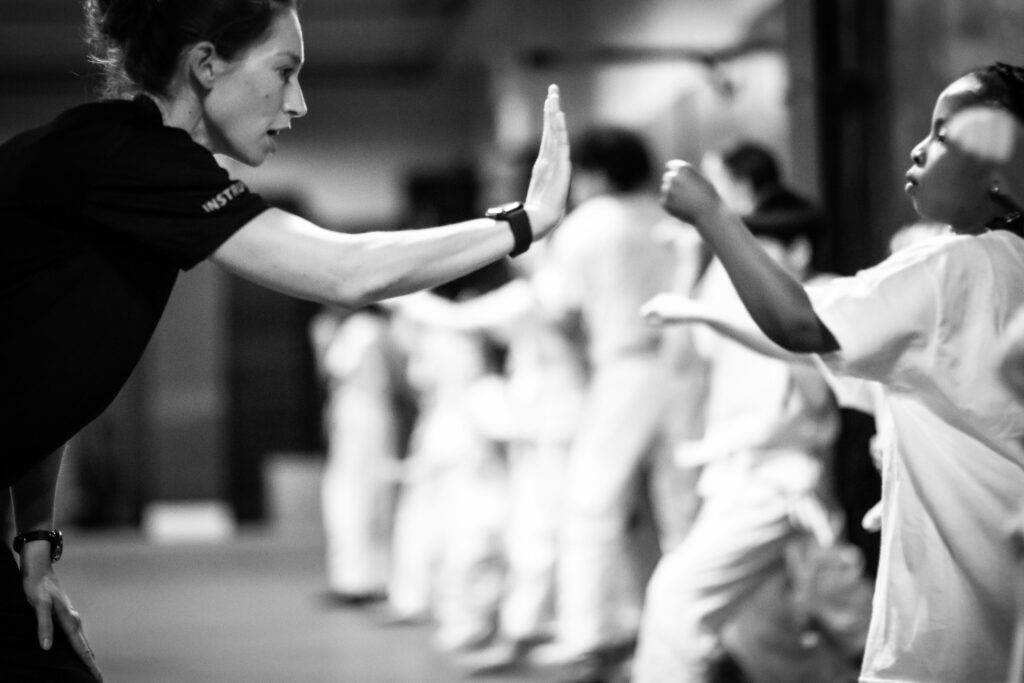
By Rachel | Founder, Combat Club NYC | Instructor & Mom
I want to tell you about a kid I’ll call Mike.
Mike was ten years old when he walked into Combat Club. He was funny, energetic, and absolutely everywhere at once. Within the first five minutes of class, he’d wandered off the mat twice, called out something irrelevant that made the other kids laugh, and was watching everyone in the room to see who was paying attention to him.
As an instructor and a mom, I recognized him immediately. Not as a “problem kid.” As a kid who hadn’t yet learned to read the room — to notice what was happening around him, regulate his own response, and make a better choice. Those aren’t school skills. They aren’t therapy skills. They’re self-defense skills. And they were exactly what we were going to teach him.
Three years later, Mike is in our Black Belt program. His teachers report he’s easier to reach in class. At home, his mom says he still complains about homework — but now follows it with:
“I have to do the hard work or I won’t improve.”
— Mike, age 13. Three years at Combat Club.
That sentence didn’t come from his parents. It didn’t come from his teachers. It came from the mat — from hundreds of hours of learning that effort and outcome are connected, that discomfort is information, and that you can choose how you respond to both.
If you have a child who struggles to focus — whether they’ve been diagnosed with ADHD, are being evaluated, or simply seem to operate on a different frequency than most classrooms can accommodate — this post is for you.
First, Let’s Reframe What We Mean by “Self-Defense”
Most parents think of self-defense as a physical skill. How to block a punch. How to get out of a hold. And yes — we teach those things. Our hybrid system combines Krav Maga, Brazilian Jiu-Jitsu, Boxing, and Muay Thai, and our students learn real, practical techniques.
But here’s what we know after years of teaching children: the physical techniques are only half of self-defense. The other half is mindset.
In Krav Maga — the self-defense system at the core of what we teach — awareness comes before everything else. Before technique. Before strength. Before speed. A child who can read a situation, stay calm under pressure, make a fast decision, and choose de-escalation when it’s available is safer than a child who can throw a perfect kick but doesn’t know how to avoid the situation, or panics the moment something feels wrong.
So from the very first class, we’re teaching both. Every drill, every technique, every partner exercise is simultaneously teaching a child to move their body and to manage what’s happening in their mind. These things are not separable. You cannot teach real self-defense without teaching emotional regulation, situational awareness, and decision-making under pressure.
For children with focus challenges, this turns out to be exactly the kind of learning environment their brains need.
What the Research Says About Martial Arts and ADHD
The science here is more robust than most parents realize. These aren’t feel-good studies. They’re peer-reviewed, with measurable outcomes.
- A 2015 study in the Journal of Attention Disorders found that just 30 minutes of moderate physical activity significantly improved executive functioning and impulse control in children with ADHD.
- A 2020 study in Frontiers in Psychology found that martial arts training specifically improved working memory, attention, and self-regulation in children — beyond what general physical activity achieved.
- A combined analysis of two randomized controlled trials published in PubMed Central found that judo training improved response inhibition — the ability to pause before acting impulsively — in children with ADHD, with measurable changes in brain activity
- An 18-month Taekwondo study found sustained improvements in selective attention in adolescents with ADHD — and its researchers recommended martial arts be incorporated into school health plans as a non-pharmacological intervention
Why does martial arts outperform general exercise in these studies? Because of exactly what we described above. A child can drift mentally through a soccer game. They cannot drift through a sparring drill. Every moment on the mat requires active attention, real-time decision-making, and physical self-regulation simultaneously. That combination — mind and body working together under structured pressure — is what researchers believe drives the executive function improvements.
The Invisible Curriculum: What’s Actually Being Taught
One parent — whose son had been at Combat Club for six months — said something that has stayed with me:
“The instructors somehow weave in lessons about self-discipline and even public speaking through the physical training. My son remembers lessons about focus, respect, and leadership because he’s practiced them — not just heard them.”
— Combat Club parent, 6-month student
This is the thing we can’t always explain in a brochure, but that parents feel within a few weeks of their child starting: there is a whole layer of learning happening that isn’t visible as “a lesson.”
When we ask a child to hold a stance under fatigue, we’re teaching them to tolerate discomfort without quitting. When we ask them to demonstrate a technique to the class, we’re teaching them to communicate under pressure. When we pair them with a partner and ask them to read what’s coming next, we’re teaching situational awareness — one of the foundational skills of self-defense, and one of the foundational skills of navigating a school hallway, a difficult friendship, or a moment of conflict.
None of this is announced. It’s just the nature of what real self-defense training requires. And for children whose brains are wired to learn through doing — through movement, through physical feedback, through immediate cause and effect — this kind of learning sticks in a way that sitting at a desk and being told to focus simply does not.
What We Did Differently with Mike
When Mike first came to us, our instinct wasn’t to manage his behavior. It was to understand what he was telling us with it.
The calling out, the wandering, the performance for his peers — these weren’t random. He was seeking something. Attention, yes. But more specifically: he wanted to matter. He wanted to be seen as capable. He just hadn’t yet found a context where that was possible.
We noticed early that he came alive during the most physically demanding parts of class. Not the technical sequences — the heavy parts. The striking, drills. The moments that required his whole body and left no mental space for distraction.
So we gave him more of those moments. And when he did something well — really well — we named it in front of the group. Not flattery. Specific, earned acknowledgment: “Mike, show everyone that block. That was exactly right.”
The attention he’d been chasing through disruption? He started earning it through competence. And competence — unlike performance — is something you can build on. It’s also something that transfers.
His teachers noticed. His mom noticed. He is now, at 13, confident enough to stand up for himself and his peers — not with his fists, but with his voice. He knows how to read a situation. He knows he has options. And he knows that doing the hard thing is how you get better.
Those aren’t martial arts skills. They’re life skills. But we got there through the mat.
When the Challenges Are Bigger: ADHD and Neurodiversity
Mike’s story is about focus and attention. But we also work with children whose challenges run deeper — kids with ADHD combined with autism spectrum traits, sensory processing differences, or other learning profiles that make traditional structured environments genuinely difficult.
One father enrolled his son at age 10, navigating a complex neurodiverse diagnosis. His review, after months of training, included a line that captures what we try to do:
“Best practices from traditional martial arts and innovative training methods… make it exciting and fun. The training has clearly benefited my son by fostering patience, self-confidence and maturity.”
— Combat Club parent
Patience. Self-confidence. Maturity. These are the outcomes of a child who has been asked, repeatedly and safely, to manage themselves under pressure — and who has discovered that they can.
Our instructors are trained to meet children where they are. We redirect rather than punish. We find what each child does well and build from there. We create an environment where the expectation is high and the support is real — because that combination is what allows children who have struggled elsewhere to finally find their footing.
An Honest Note on What We’re Not Saying
Combat Club is not a clinical intervention. We are instructors — experienced, deeply committed ones — but we are not therapists or physicians. Martial arts is not a replacement for medication, therapy, or a thoughtful behavioral management plan developed with your child’s doctor.
What we are saying is this: for many children with focus and attention challenges, a structured physical environment that demands both mental and physical engagement — where the “soft” skills of self-regulation, decision-making, and situational awareness are built into the training itself, not bolted on as a separate lesson — can produce real, lasting change.
The research supports it. Our students show it. And the parents who bring their kids to us tell us, often with visible relief, that they’ve finally found somewhere that works.
Come and See for Yourself
We offer a two-week free trial with a free uniform — no commitment required. Come in, let your child try a class, and watch what happens when they’re in an environment built around how they actually learn.
Combat Club is located in Tribeca, easily accessible from across downtown Manhattan, the West Village, and Brooklyn. We work with children ages 5–13, with a leadership track for teen students who are ready for the next level.
→ Book your free trial at combatclub.cc
Research Sources
1. Pontifex et al. (2015). Journal of Attention Disorders. Exercise improves behavioral, neurocognitive, and scholastic performance in children with ADHD.
2. Ludyga et al. (2020). Frontiers in Psychology. Martial arts training and executive function in children.
3. PubMed Central Combined RCT Analysis (2023). Martial arts and cognitive control in children with ADHD.
4. Kadri et al. (2019). International Journal of Environmental Research and Public Health. Taekwondo and cognitive function in adolescents with ADHD.
5. Frontiers in Pediatrics (2021). The effect of martial arts training on cognitive and psychological functions in at-risk youths.
6. CDC (2023). Data and Statistics About ADHD. Centers for Disease Control and Prevention.
